
Part three
Assignment 3 – Research.
Henri Cartier – Bresson (1908-2004) A French photographer and founding member of the Magnum photos in 1947, who is most famous for creating the most highly debated concept in photography history known as, The Decisive Moment. Cartier – Bresson created The Decisive Moment in 1952 in a book called “La Sauvette” which, was translated by Dick Simon to an English title as the Decisive Moment. As Kim, E (2010) explains; “The decisive moment is the split second of genius and inspiration that a photographer had to capture a certain moment”. Cartier – Bresson believes that if you miss it – it’s gone forever, its all about timing and those fine details for example, eye contact. He believes you must look for moments to capture. Cartier – Bresson is obsessed with composition, form and the aesthetics of photography much different to Waplington who doesn’t believe in pre planning a ‘moment’ and that composition is of relevant detail as any image holds/tells a story hence why he believes Cartier – Bresson views are dated. Cartier – Bresson most famous image associated with the Decisive moment is the image of behind the Gare Saint – Lazare In Paris 1932 (please see below). This is a perfect example of right place, right time to get the boy elevated in the air jumping the puddle something which Cartier – Bresson puts down to luck as he couldn’t see through his view finder (O’Hagan, S (2014).

Matt Stuart – (1974) A british photographer who has been focussing on street photography for the past twenty years mostly based around London. Stuarts work is inspired like many others by Henri Cartier Bresson but he has own style which, includes humour and colour. I find his images fascinating and influential, hence why I wanted to add him into my research towards my assignment. In the words of Matt Stuart: Buy a good pair of comfortable shoes, have a camera around your neck at all times, keep your elbows in, be patient, optimistic and don’t forget to smile (Stuart, M 2018). Stuart was inspired after being gifted from his father an aperture monograph by Robert Frank and a photobook by Henri Cartier Bresson his love for photography began at age 22 (Strecker, A 2010).
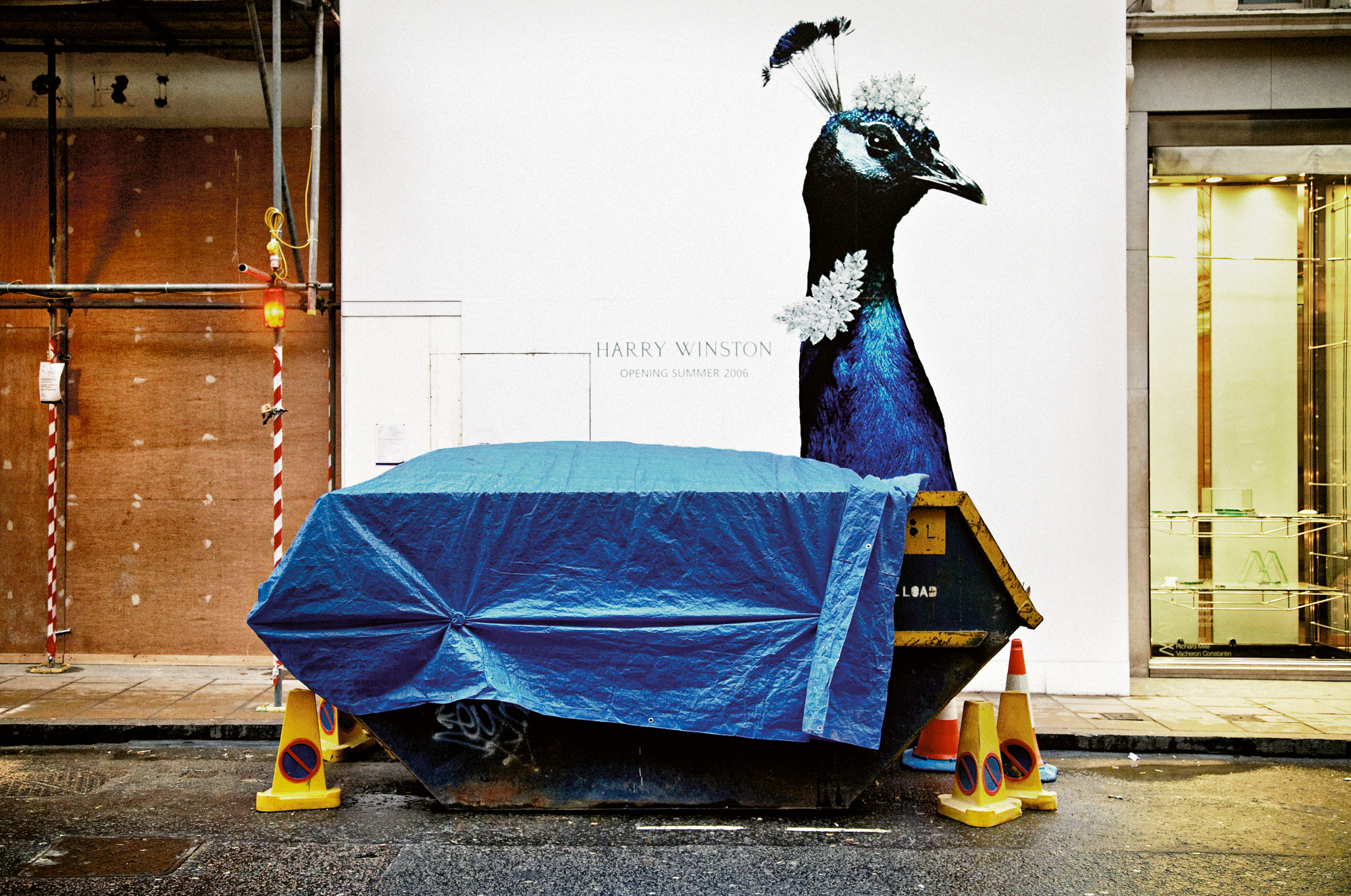
David Sark – A Sydney based photographer who has a background in the subjects visual communications and graphic design. Sark has written some interesting articles based around street photography and the indecisive moment. He explains the indecisive moment as “process of observing a scenario and being prepared or even pre-empting when to take the photo in order to capture the moment that best tells the story of what is taking place” (Sark, D 2018). When Sark heads out to do his street photography he doesn’t usually just take one shot of this particular moment he tends to use the burst mode and take 3-4 shots at any one time. This allows for subtle differences to be captured even though they are of the same image. Even though they are matters apart Sark says: they have their own feel. Sark has some interesting tips on street photography which would be useful for my assignment three. He says that street photography is about capturing the unplanned and unexpected moment. He would go out and look for those unique characters and find a scene that he thinks would take good photos and often it is about waiting for the right person to enter that frame to make that perfect photo. Sarks other tips on street photography would be to steer away from “phone zombies” – its much more interesting to get photos of peoples facial expressions, gestures and the finer details rather than just someone looking at their phone zoning out from the world. Also, to try and shoot at different times of the day. I have chosen to show this example of David Sarks street photography below, I think it leaves so many questions unanswered. Is it a business man off to work early in the morning? Is it a business man finishing work late at night? Let your mind imagine its own story.

Garry Winogrand (1928-1984) An American based street photographer who was famous for identifying America’s social issues and lifestyle. Winogrand was known for his images that gave out the message “seeing life as it was” and had become a master of capturing the perfect candid moment, or as Henri Cartier – Bresson would call it “the decisive moment”. Winogrand is different to Cartier Bresson though as he has veered away from the ‘perfect picture’ and following the photography rules. Instead, Winogrand is known for his tilted, poorly composed images and is said to have stepped away from the generic rules of photography and pushed the boundaries. He hopes that in future generations they follow his lead in creating your own rules and ways of capturing images. Winogrand was often seen walking down the streets of New York snapping away with his camera held away from his eye. (The Art Story 2017).

Nick Waplington – (1965) A British ‘artist’. Waplington does not describe himself as a photographer as he is interested in everything . He is actually a painter but predominately his work is photogenic. Waplington is famous for writing the book the “Indecisive memento” written in contrast to Henri Cartier – Bresson’s book The Decisive Moment. Within this book Waplington states some useful facts. when Waplington sets out to take his images he does not pre visualise what he is going to take instead he goes with an idea and slowly this evolves as he begins capturing scenes. He says you can photograph anything and it can hold a sense of resonance. In Waplington’s opinion the Cartier – Bresson approach on photography is dated and that given the more abstract and unique photographers that are becoming more known at this day and age new rules are being created (photopedagogy NDG).

Research Point – The decisive moment.
My Opinion on the decisive moment – I feel as though the decisive moment can take a moment or two to get your head around. There are lots of different variations of the same meaning. Do I believe in the decisive moment? Absolutely – I do think that any image can be part of a decisive moment some are just more staged that others. I do like the way Meyerowitz looks at the decisive moment. Meyerowitz was interviewed by Leo Benedictus for The guardian, here he explained that street photography helps to carry a moment, it shows you the past to present in the sense of a time capsule. Meyerowitz followed Henri Cartier – Bresson’s decisive moment way for over ten years and decided to try moving away from the Cariter – Bresson theory and be more expressive and dynamic. Cartier – Bresson folcuses on putting the action in the middle of the frame but Meyerowitz trialled with different angling and space (Benedictus, L 2009). I like that Meyerowitz has more of a understanding of what he wants to portray within his images for example he said people will look back and say that’s hat New York use to look like 75 years ago (you can see this image below). It doesn’t seem as staged as Cartier – Bressons work who seems to focus more on the composition, geometry and finer details.

Zouhair Ghazzal on Henri Cartier – Bresson.
Zouhair Ghazzal is a photographer based in Chicago and has written his views on ‘the decisive moment’ similar to Colin Pantall who reviewed Paul Graham’s work. The decisive moment was formed by Henri Cartier – Bresson in the 1930’s he says that “its always luck. It luck that matters, you have to be receptive, that’s all. Like the relationship between things, its a matter of chance, that’s all. If you want it, you get nothing. Just be receptive and it happens”. Ghazzal describes the decisive moment as small and unique and something which cannot be repeated. However, he does believe that it is more of a cliche than reality. Most photographers have had to study the decisive moment to be able to produce and create their own work (Ghazzal, Z 2004) Although, it works better for bodily images such as when Cartier – Bresson captured peoples gestures as no two gestures are alike – Ghazzal believes it does not work as well for landscapes as they are too uninteresting. The decisive moment really has to be a ‘right place right time’ scenario whereas, like Ghazzal I believe photographers could be trying to hard to get that ‘decisive moment’ and therefore, its becoming too stages and becomes more of a narrative similar to Graham’s work below.
Colin Pantall on Paul Graham (1956) – The Present.
Paul Graham is a documentary and fine art photographer based in England and was one of the first to combine colour photography along with documentary in the 1980’s. Graham produced a collection of street photography based images in a series known as ‘The Present’. These images included people walking the streets of New York and was presented in the form of a book. Colin Pantall (2012)explains that Grahams work makes you flick back and forth between images, you will study an image – then go back to see what was similar or what has changed from the previous image. These are not necessarily ‘decisive moment’ images as he is selecting where to take the photos and when, they are done very synchronised and come across as more narrative. One photo leads on from another and this gives a story based feel to it (Badger, G 2019). Gerry Badge does an interesting view in the 1000 magazine and he states that as the images are in either duos or trios it gives a drama based feel to it in a rather formal like manner. This is a great link https://www.youtube.com/watch?v=_iw2zDsXQDc where you can see Jorg Colberg (2012) go through ‘The Present’ book/images – I found this rather interesting.

Francesca Woodman (1958-1981)
Francesca Woodman was a photographer who created rather dark looking images based on personalised psychodrama who sadly committed suicide at just 22 years old. These shots are created by long exposures and consist of blurred movement which diffuse the figure captured. Gerry Badger reviewed the work of Woodman and says that it has an 1970’s American feel to it as they have tendencies to combine their photography with their personalised psychodrama. Woodman focuses on framing her images in empty spaces/rooms with minimal props used, when she does use props they consists mainly of mirrors and vitrine (G, Badger 2019). Tim Burrows (2010) explained in ‘anothermag’ that he believes her images hint at her suicide and that they are more of an abstract piece of work. When Woodman would show her face within her work, she always had a blank like expression and a face that posed as possessed in Burrows opinion. Please see an example of her work below.


Christopher Doyle (1952)
Christopher Doyle is a cinematographer and actor from Sydney, Australia. He is famously known for shooting several films such as; Paranoid Park, Hero and Chungking Express in which he worked closely with Wong Kar – Wai. The film Chungking Express was shot by Doyle In 1994 in just 23 days and was shot in the busiest part of Hong Kong centre (Lee, A 2019). It was within this location that they filmed the opening scene which, was a chase through the market. Doyle shot this scene so quickly at 1/8 of a second that it created movement blur, something which you wouldn’t usually see in movies (Angelo, M 2013) this was created by removing every second frame whilst duplication the others something known as the shutter step effect. I have screen shot from a YouTube clip of the opening scene of this movie to show you the effect speed and time can have. The link to see this yourself is here: https://www.youtube.com/watch?v=DZ1feC67GO4.

Gareth Davies.
Gareth Davies is a London based photographer who focuses on panoramic images. Davies created these images using wide – view and slit scan methods with a camera which he built himself inspired by Michael Disariez. For the split scan images Davies used a rotating panoramic Larscan camera which, was self built. As Bob Erickson explains, a Larscan camera works on the basis that there is a stationary disc inside the camera body, the film then gets pulled through by a motor through the camera and held still by the disc as the camera rotates 360 degrees around it. For this to work the diameter of the disc needs to be double the focal length of the lens. There is an example of two cameras that Gareth Davies has built below. Also below you can see an image that this camera produced, this image shows him riding a tricycle through the Wellington Arch in Hyde Park, London. As you can see this technique and method emphasis’s the movement of time through an image. In my opinion I feel like I am also riding on that tricycle and going on the journey with him.

Maarten Vanvolsem (1974)
“Looking for time in the image”. Maarten Vanvolsem is photographer from Brussels who explores expressing time through photography. Vanvolsem is well known for his series of images called Contraction of Movement created in 2007, please see an example below. He focused on a technique called strip – scan this skill captures the single line of frame in sequences which creates the image over a matter of time. As Vanvolsem explained in the image and narrative article in 2008 it creates a contraction of movement, the distorted background and moving the still camera results in more limbs being noticeable and no face, this gives the impression of the person spinning (dancing) in a right to left linear motion. Many people reflect on the relationship within the photographic image – often this comes down to time. It’s not the object being captured but actually the depiction of time (Vansielegham et al 2016). People are always wanting to freeze time, instead photography can contrast movies as a moving medium. Move the camera and create a film inside it this will create a time based composition (Vanvolsem, M 2014).


Jo Longhurst (1962)
I am researching Longhurst as part of my suggested reading through my assignment two feed back as I focused my assignment on canines and Longhurst too has done a series of photos ‘twelve dogs, twelve bitches’. Jo Longhurst is a UK based artist and photographer and has worked on a project which she named “The Refusal” that included 24 portraits of British show whippets a series which she named twelve dogs twelve bitches. She chose this subject as part of a personal matter after she went into showing her own whippet called Vincent and because she wanted to research further into the ‘perfect’ dog In the series Longhurst focused on removing the whippets traditional heavy leather collars and replaced it with what looked like fishing wire that was held in an upright position but almost completely blanked out by the studio lights. As the Hotshoe magazine 2008 explained within their article this is to emphasis a sense of control. The white backdrop background highlights their form and defines their shape. In my opinion looking at the twelve dogs and twelves bitches separately it allows you to look for comparisons you can really notice the difference between the way the dogs and the bitches carry their tails. I enjoyed looking at this series, as well as creating technical and interesting images you can expand your thinking as a viewer into the way the dogs are breed to be more visually pleasing for the judges. I like the way that Longhurst removed the leather collar as in my opinion this allows us viewers to see more of the dogs neck and she still kept that thin piece of string which, made the dog stand to attention as if in a show ring. The series actually allows you to be the judge and enables you to chose which one is the ‘perfect’ dog in your opinion and I like that!

Harold Edgerton (1903 – 1990)
Harold Edgerton first began as an electrical engineer and received a degree In electrical engineering in 1925. and found his passion for photography when he started to photograph his scientific experiments. It was his first experiment that he tried to form the perfect Coronet from just one droplet of milk. To fulfil this experiment he created something called a ‘stroboscope’. A stroboscope creates short bursts of light this resulted in images taking split second pictures of subjects in motion which, the human eye cannot see. Some of Harold’s photos had exposure times less than 1/10,000 per second. Harold was known as the explorer of strobe photography and his skill allowed him to capture images such as; balloons bursting and bullets hitting an apple. Harold got the nickname of ‘papa flash’ from his discovery and even helped to find the American civil war battleship USS monitor under the sea as well as finding the Britannic, this was through using side scan solar technology.

Jeff Wall (1946)
Jeff Wall is a Canadian photographer who creates and produces large scale imagery. Jeff includes elements of fine art, borrowing narrative and visual details into his photos all varying from different genres. Most of Jeff Walls images are created from experiences he has either seen, heard or read up on, he will then react this by creating and staging a scene showing frozen moments that happen in the middle of events. For example, the image ‘Milk’ as shown below, an image made through large back light transparency (187cm x 229cm). In this image there Is a harsh geometric background, which makes the scene stage like. The man has a clenched posture alongside the milk spillage it recreates the anger emotion.

Philip – Lorca DiCorcia (1951)
Philip – Locra DiCorcia is an American photographer who mostly focuses on capturing people and places. Each photo has planned compositional strategies, objects are placed purposely and he ensures the lighting and framing is precise. Philip works most commonly in colour. One of his most famous series of street photography images are ‘Heads’. This series shows photographs of people walking through the city of New York. Philip stages these images so that the light illuminates an isolated their heads, this allows the viewers to have a closer inspection and see significant details which may get lost amidst the usual hustle and bustle of city life. These people were also completely oblivious to Philip taking the photos. Please see an example below. In my opinion, the way that he has planned and created this series it portrays the people in a film star/celebrity way.


Part two
Ansel Adams (1902 – 1984)
Ansel Adams is a photographer born in San Francisco, California and was mostly known for his great photography of landscapes however, it was known that he was unusually talented at commercial photography and worked on anything from portraits to catalogues. This however, was for more of the financial benefit than it was of love. He is very well known for his black and white West American landscape images. Adams also went on to write ten volumes of manuals in photography and they are some of the most influential out there. Adams helped to create a group called F64 which, included 11 photographers. Their aim was to keep photography “pure”. The group name came from the smallest aperture setting which, produces a crisp background and sharp depth of field (Fargon Jene, O 2015). Most of Adams photographs have an extensive depth of field and he states that it is the position of the aperture that is important in producing that clear picture with defined detail.

As part of my research point for Project 2 Lens Work I have included below an image which, I have found out of my own archive. An image which I have named ‘walking into the distance’ it has a deep depth of field – showing the viaduct pathway going off into the distance. It is also set in black and white something which most of Adams work illustrates also.

Fay Godwin (1931-2005)
Fay Godwin was a British photographer who mostly focused her work on portraits at first but her interest soon began apparent in Landscape photography. She worked closely with a poet writer called Ted Hughes who agreed he would write poems to illustrate her pictures. Godwin, works mostly in black and white although, in the 21st century she began moving onto colour and digital imagery looking more at beaches, nursery gardens and small scales photos (Lenman R & Nicholson A 2005). Godwins work is similar to Ansel Adams in the sense of passion for landscape photography, working in monochrome and also capturing mostly in deep depth of field.

Gianluca Cosci (1970)
Gianluca Cosci focuses his work with shallow depth of field. Cosci states that he tries to put the emphasis on both subject of the photograph and the way it is photographed for example the position. Often the point of view is marginalised and this results in restricted views. Although I find his work creatives, I don’t feel my mind wanders as much as it does with the like of Ansel Adams and Fay Godwin. I feel that the emphasis really is on one key element of the photograph. Below is an example of this work in shallow depth of field from the series called Panem et Circenses.

Campany & Colbreg Reviews:
Whilst working through my handbook I researched a research point under project three; surface and depth. For this I needed to read blogs reviews on the art of the pixel by both David Campany and Joel Colberg.
David Campany review on Thomas Ruff.
Thomas Ruff is a German photographer who was born in 1958 and is described as a master of edited and reimagined images. Ruff explores the visual effect of jpeg compression which, is blocks of 8×8 pixels also known as jpeg artifacts within his book called jpegs. David Campany wrote a review on Ruff’s work in 2008 called “Asthetics of the Pixel”. Campany describes his work as cold and dispassionate but surprisingly beautiful. All his photographic images come from archives of many different forms of photographic images in different formats such as: film formats, camera formats, the computer image file and modern art gallery just to name a few. Ruff created a archive grid to try and order the ‘chaos’ and selected his own choice of images. These images were blown up beyond photorealist resolution and Campany explains this allows us to look at these images as figuration and as abstract. Many of the images Ruff chose are of unpredictability; fire, water, smoke, steam and explosions. Ruff’s work on pixels is very different but capturing as Campany explains pixels are grid like, they do not have this scattered effect like grain does and he believes that pixels are replacing that grain effect that the photographic film produced.
Joel Colberg Review on Thomas Ruff
Joel Colberg wrote a review on Thomas Ruff in 2009. Colberg identifies to us what inspired Ruff to begin looking into pixels. It began with the 9/11 attack on the World Trade Centre. When he got the negatives back from the lab they were all blank this spurred him on to look on the web for images and that is when he began experimenting with pixels/jpeg images. Colberg describes Ruff’s images as terribly beautiful and prefers to see them in the book than in person at the Zwirner gallery as he finds these are too big and the little detail that are in the images are hard to see in the gallery itself. Colberg explains he has a unease with Ruff’s work and that the concept relies a little too much on technique. He is left with questions like; What else Is there? He finds it a little too obvious stating that “Of course if you blow up an image it will show funny patterns”.

I have taken one of my shots of Polkerris Bay resized the image to 180×270 pixels and saved it as zero quality to create the same effect as Ruff, please see below.

Andy Sheng
Andy sheng is a studio based photographer who focuses on animal photography. I love Andy’s quote: “A successful dog photo captures the natural beauty and personality of the dog”. Andy offered some great advise on shooting puppies – because they are less active and likely to sleep through a photoshoot it allows you to use low iso with no flash and a slow shutter speed although he does recommend that you use a tripod to avoid camera shake. As well as technical advise Andy also suggested ways that help the dogs throughout the shoot for example saying a command such as ‘sit’ is a great mental exercise to get the dog thinking. It is not just a perfect portrait image or a head shot that Andy focusses on he says every dog has something unique about them maybe a whirl in their coat or a marking that stands out, he recommends to take close ups as this is a more abstract way of photographing them.

William Wegman
William is an art photographer who was born in 1943 in Massachussets and now currently lives in New York. He is well known for his artistic paintings which, are shown in galleries and exhibited around the world, in countries such as, New York, Paris and London. William is best known for his series of photos that are of his own dogs dressed up in humans clothes known as ‘Stationery Figures’. He composed this of eleven glass mosaic panels of his own portraits. The dogs are dressed in human like clothes and positioned huddled together as if waiting for a train. William explains that he dressed them in bold bright colours and nothing to fashionable and wanted the colours to show off their skin textures, facial expressions and patterns.

Kaylee Greer
Kaylee Greer is a pet photographer based in Boston and is known for her great saturated pictures and bright colourful backgrounds. Her work is published in many major famous industry editorial titles. Kaylee does things a lot different to Andy Sheng she believes in no backdrops no artificial lights and is the complete opposite hence why I wanted to explore her work further. Kaylee prefers to focus on natural lighting and natural settings and will take her clients on an adventure to find the perfect location rather than a studio setting. Kaylee also worked on an article based around whether flash light was safe to use for dogs, please see link in my references on assignment two. Kaylee commonly uses flash light in her photoshoots as it fills in harsher shadows and can bring out details you might not otherwise be able to capture.

Neil Leifer
Neil Leifer began photography in the 1960’s and is best known for his sports photography especially capturing boxing matches. He has written 16 books, 9 of which have been based around sports photography. Neil has photographed at 16 Olympic games and four fifa world cups. He is now a full time film maker, producer and director. His photos inspired me and captured my interest because of the expressions and emotions that he portrays through them. Although a different scenario, dogs can also express a lot of their emotions through their posture and actions and this is something I want to try and capture in assignment number two – collecting.

Part one
Martha Rosler – The Bowery In Two Inadequate Descriptive Systems.
Martha created a text piece of photography called The Bowery in two inadequate systems which is currently on display in the Lethaby gallery in Central Saint Martins. This consisted of twenty one black and white images, twenty four text panels and three blank panels as part of an experiment to see how the photo text applies to social reality. Martha Rosler has played key roles in debates along contemporary art (Edwards. S 2012). The text in which Martha uses are all associated with drunkenness written in poetic ways and were all captured in the New York Bowery District. Please see an example below.

Olivo Barbieri
Olivo Barbieri is an Italian photographer who works in capturing natural and urban environments. He is most well known for capturing images from a helicopter using a tilt shift lense and shallow depth of field which, creates the idea that an object is infact a model (see example of his work below). By tilting the lens angle to the back of the camera it creates gradual blurring this is commonly known as selected focus. As you can see from the example below Los Angeles appears like a small model version from the use of this technique.

Uta Barth:
When my tutor asked me what I wanted to gain from the course I laughed and said I want to take better photos – we discussed this as he had explained to me that not everyone has the same thought on a ‘good’ photo and that there was an artist called Uta Barth that deliberately takes out of focus photographs. Uta creates this blur by focusing on an unoccupied foreground – this was part of one of her recent studies of photographic presentation. Uta has two series of photos that apply this deliberate blur these are called Fields and Grounds. Grounds, which Uta began in 1992 are captured inside, to create this blurred imaged Uta used something to stand in the foreground of the composition. She would set the camera to focus on this collaborator which, would then move out of the frame and therefore leave this empty blurred space. Uta explains that she is mostly inspired through film and the reasoning behind her deliberately blurred photos are that she wants the viewer to think of their own activity when looking at the image. I actually find these pictures quite refreshing because they aren’t focused on anything specific it allows my mind to wander to ‘complete’ the picture in my own imagination.

When I read the brief for assignment one I decided I would like to retrace somewhere I knew very well and that is Luxulyan Valley & Prideaux. This also gives me chance to base the photos around my childhood and to give viewers and insight into where I spent a lot of my time as a child and why these places mean so much to me.
Whilst looking through the practitioners recommended to me there was two that particularly caught my eye.
Firstly, Tom Hunter whom is a Professor at the University of the Arts, an artist who is specialised in photography and film. In 1994 Tom Hunter graduated from the London college of printing with this famous work, The Ghetto, this is now on display in the Museum of London. The reason Tom Hunters work appealed to me was because he explored his Neighbourhood and reconstructed stories and memories through his photographs which, is something I am aiming to do with my series of photos within this assignment. Tom focuses on using other worlds as well as our world/times to create mythical and psycho geographical landscapes. Although, I was not wanting to embrace the mythical side I did like his idea of embracing the ancient world and linking this to modern times, this gave me the push to look into the history of Luxulyan Valley so I too could try and capture the history within my photographs.
Whilst continuing to research more of Tom Hunter, I wanted to see whether there were any other photographs that could inspire me more. This is where I found his gallery and an album called ‘Findings’. In these series of photos Tom has captured what was once someone’s working life – similar to what I want to try and capture at Prideaux. Tom explains this album as capturing the ‘disappearing world – illuminating and documenting a special place’. The photos he had taken were of a working place that his Grandfather was involved in. Similarly, Prideaux is a place that my Father as involved in before all of the racehorses were sold. I really liked Toms thoughts behind these photos and hope to use these to expand my ideas for my series of photos.

Aside from Tom Hunter, the other photographer who I was interested in was Jodie Taylor. Jodie Taylor is a third year student with the OCA and was working on her advanced project. Jodie captured her childhood through a series of photographs that helped to form and create memories from her past. What really captured me about Jodie’s work was that her pictures weren’t particularly scenic they were photos of graffiti on garages, photos of overgrown back alleys yet the photos could tell you a story and you could almost visualise your own childhood there. This gives me confidence to go and take photos that are memories to me of my childhood regardless of whether they are of beautiful surroundings or not.

Next, I researched Luxulyan Valley. To really get the information within my photos of the history within the Valley I felt I needed to educated myself further on what the Valley use to be used for. I knew there was a lot of history held within it and often wondered what some of the buildings were and what they were once used for. I knew there was a group called friends of Luxulyan Valley that help to look after and maintain the area so I looked them up and saw that Stephen Austin wrote an article on the history of the Valley in 2008. The valley itself was used for variety of jobs. It was no good for farmland as it was too deep, although now I see there are some ponies grazing in the side fields. It was far to steep to build any housing estates on and it was too rocky to stream tin – but that did not stop it from having its uses. In Prideaux right near the valley there is a 2000 year old hill fort and deep in the valley appears to be some mediaeval dwellings. In 1730 vessels weighing a massive 80 tonne would moor at the Bays within the valley but unfortunately due to the tin streamers working at the top on Goss Moor it soon got filled with rock, sand and soil which, resulted in them no longer being able to stop there. The shoreline was pushed back 2 miles right back to Par Beach and over 500 acres got filled in with sediment. As Stephen Austin explained a man called Joseph Treffery inherited the Valley, he took on the challenge to build two inclined railways which lead to the mines. He then build the famous viaduct which is, 650ft long and 100ft high this was completed in 1842. Beneath the viaduct lay the waterchanel and water level was maintained by the 34ft wide waterwheel. This is what created the waterfall that my sister and I loved so much. The valley is also well known for its china clay and china clay trains weighing 1400 tonne still pass through the valley today.

References:
 Heather Wade OCA Blog