
Brief
Create a set of between six and ten finished images on the theme of the decisive moment. You may choose to create imagery that supports the tradition of the ‘decisive moment’ or you may choose to question or invert the concept by presenting a series of ‘indecisive’ moments. Your aim isn’t to tell a story, but in order to work naturally as a series there should be a linking theme, whether its location, event or a particular period of time.
The Plan:
Brain storm all ideas down on paper – thinking about location, visual strategies, research & inspiration as well as camera technicalities. Next, put this brain storm into a plan of how I want to create and produced this assignment.
You can also view my initial thoughts here.


Research:
“There is a creative fraction of a second when you are taking a picture. Your eye must see a composition or an expression that life itself offers you, and you must know with intuition when to click the camera. That is the moment the photographer is creative. Oop! The Moment! Once you miss it, it is gone forever.” (Cartier Bresson, H).
The decisive moment is one of the most highly debated concept in the history of photography and this is down to a French photographer called Henri Cartier – Bresson. He believed the decisive moment is a split second of genius and inspiration that a photographer had to capture a certain moment (Kim, E 2010). The decisive moment came about after Cartier – Bresson produced images within a book called “La Sauvette” which, was translated to ‘Images on the run’ by Dick Simon and given the English title – The decisive moment. Cartier – Bresson is obsessed with composition, form and the aesthetics of photography, you can see more research and examples of his work here. In comparison to Cartier Bresson there is a British artist called, Nick Waplington who published a book called “Indecisive memento”. Waplington creates his work in a completely different way, he doesn’t pre visualise what he is going to take he merely goes out with an idea and allows this to evolve when he beings taking photos. This inspired me as I found the Decisive moment a minefield, so I got my idea, to go to Plymouth and followed Waplington’s theory and allowed my idea to expand once I began photographing.
Furthermore, an American photographer Garry Winogrand (1984), follows similar ‘rules’ to Waplington, in the sense he doesn’t worry about composition or being aesthetically pleasing like Cartier – Bresson. He is known for his tilted and poorly composed images and is often seen walking through New York City with his camera above his head taking snaps, held away from his eye level. Winogrand was inspired by Robert Frank (1924), a Swiss American photographer who is known for bold composition and ironic renderings of the American life (O’Hagan 2014). An example of Winogrand’s work is here (The Art Story 2017). Following on from Winogrand, I looked at the work of David Sark, a Sydney based photographer who describes the decisive moment as; process of observing a scenario and being prepared or even pre-empting when to take the photo in order to capture the moment that best tells the story of what is taking place (Sark, D 2018). Sark, offers some great advice on street photography he urges that you steer away from ‘phone zombies’ as facial expressions, gestures and the finer details are what can make the difference in an image.
When looking into the Decisive moment I thought that Henri Cartier- Bresson must of been some form of magician, how can he always time a photo right to get the perfect image? How is he always in the right place, right time and hits his shutter at the correct time? After researching I found that Kim,E (2014) had written an interesting article on “Debunking the myth of Decisive moment”, it is here that I realised Cartier – Bresson infact as many other famous photographers do, take several shots of one scene – spends time examining his images before choosing which is best. Here is an example below of Cartier – Bressons contact sheets and two images he chose between (Kim,E 2014).


Most street photographers I researched developed their images in black and white therefore, I wanted to do some research on a photographer who embraces more colour. This lead me to Matt Stuart, a British based street photographer whos images portray a sense of humor, liveliness and mischief. They’re capturing in the way theyre abstract and perfectly timed, you can see here the image of the peacock and how it looks like the skip is his body (Stuart, M ND).
With all of this research in mind, I made the decision to get the train to the nearest city centre (Plymouth) and follow Nick Waplington’s lead with not having a visual of what I was going to get out of the day but to go with an idea and see how it evolves! My idea is to capture different reasons to head into the city. For example; the elderly getting their must haves, the holiday makers on a shopping trip, the children being dragged around the shops, the market stall holders selling their goods, the teenagers trusted out alone and those out at work, business men, upperclass shoppers – these were jus a few of my ideas.
To help me with my journey I read Suler, J (2019) article on The psychology of “The Decisive Moment” which, gave 10 pointers on how to do street photography well, they are in brief:
1.Sophisticated composition
2. A background to the subject that interacts both visually and psychologically.
3. The visual and anticipation of completion and closure, which often surfaces as a visual gap, interval, or suspension.
4. An element of ambiguity, uncertainty, and even contradiction.
5. Capture something unique including movement and action.
6. A well timed unrepeatable shot.
7. People in real life situations.
8. Dynamic interplay of objective fact that arouses emotion about the human condition.
9. Overarching context of a good photographic session.
10. A psychological meaning of people, based on technical, cognitive and emotional skill.
I set out on a very hot day at the end of August, with my son in his pram apprehensive on what I might achieve. My photos were taken outside Drake Circus on the Plymouth city centre high-street.
My Series:

When I took this image I was trying to capture a market stall holder selling his fruit and veg it wasn’t until after I noticed the mans stance – he looks annoyed with his hands on his hips, he was waiting on the lady to choose her fruit, he doesn’t look impressed.

I like how this image shows two opposites, the lady sat down holding her head but the man with a similar aid still walking around.

Although I wanted to follow Sarks advice on steering away from ‘phone zombies’ this image comes across quite strong to me especially as a new mum! I was sat having a drink looking out of the shop and went to take a photo of a pigeon that kept flying down when this family walked across. The mum is engrossed into her phone whilst her child pushes her sibling.

A little girl and her grandfather charity shop shopping, she was putting a teddy into her bag. Although, a little Winogrand with the tilted frame!

I stood here for a little while looking at the reflections in the window and as I wanted to take some photos of them this man came along to look at the Rolex watches, this seems an opposite picture to the one above. Charity shop vs Rolex?

This man was thoroughly engrossed in choosing out his race horse winners whilst drinking a beer.

These traffic wardens were stood here some time deciding on whether or not to give this car a ticket?

Teenagers out having a cycle around the city.

A builder on his lunch break deep in thought.

At first I thought the lady sat on the side was the operator for the ride. It wasn’t until I took the photo that I realised she was breaking up biscuits in her hand to feed to the seagull to the left of the photo.
Contact sheets:

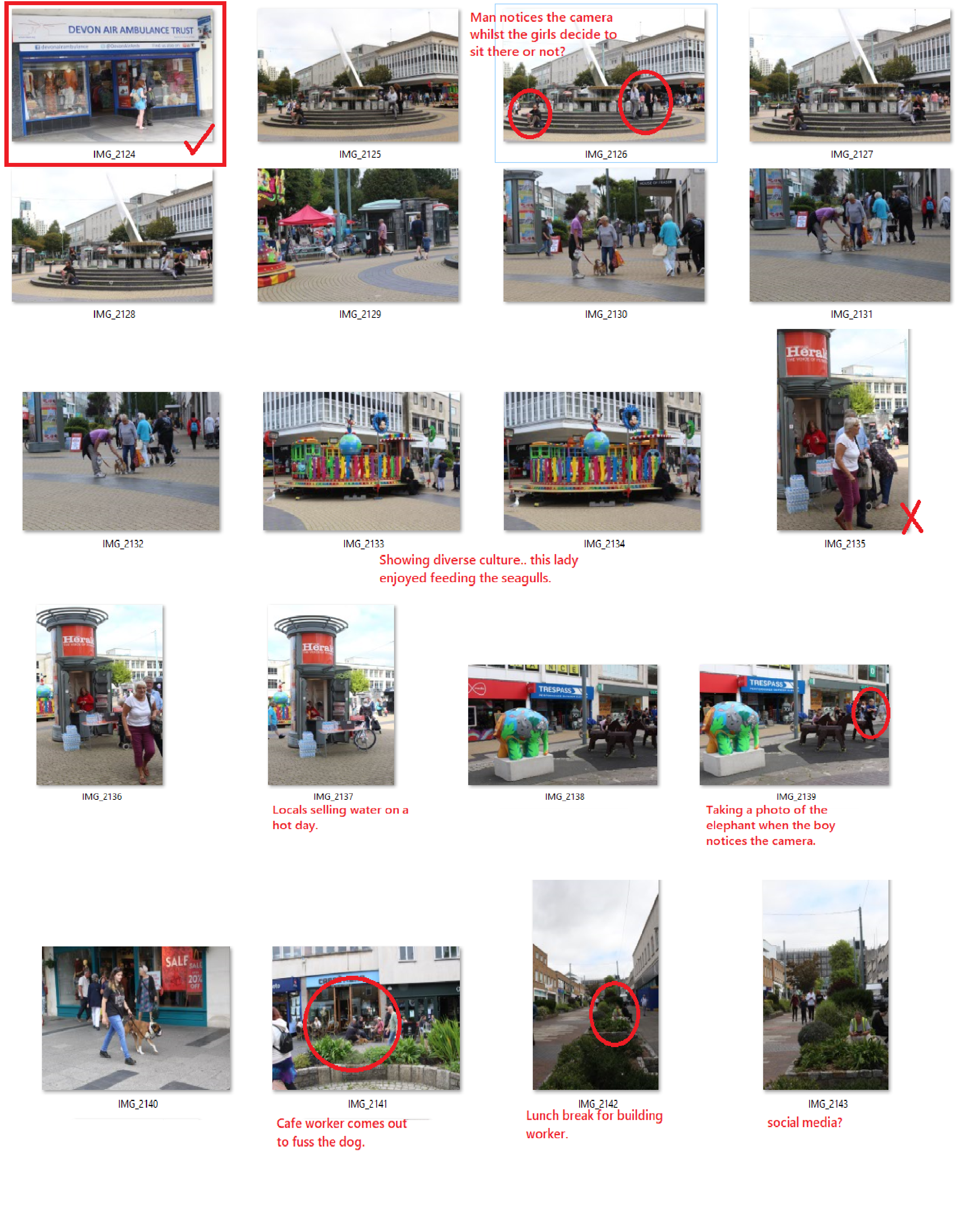
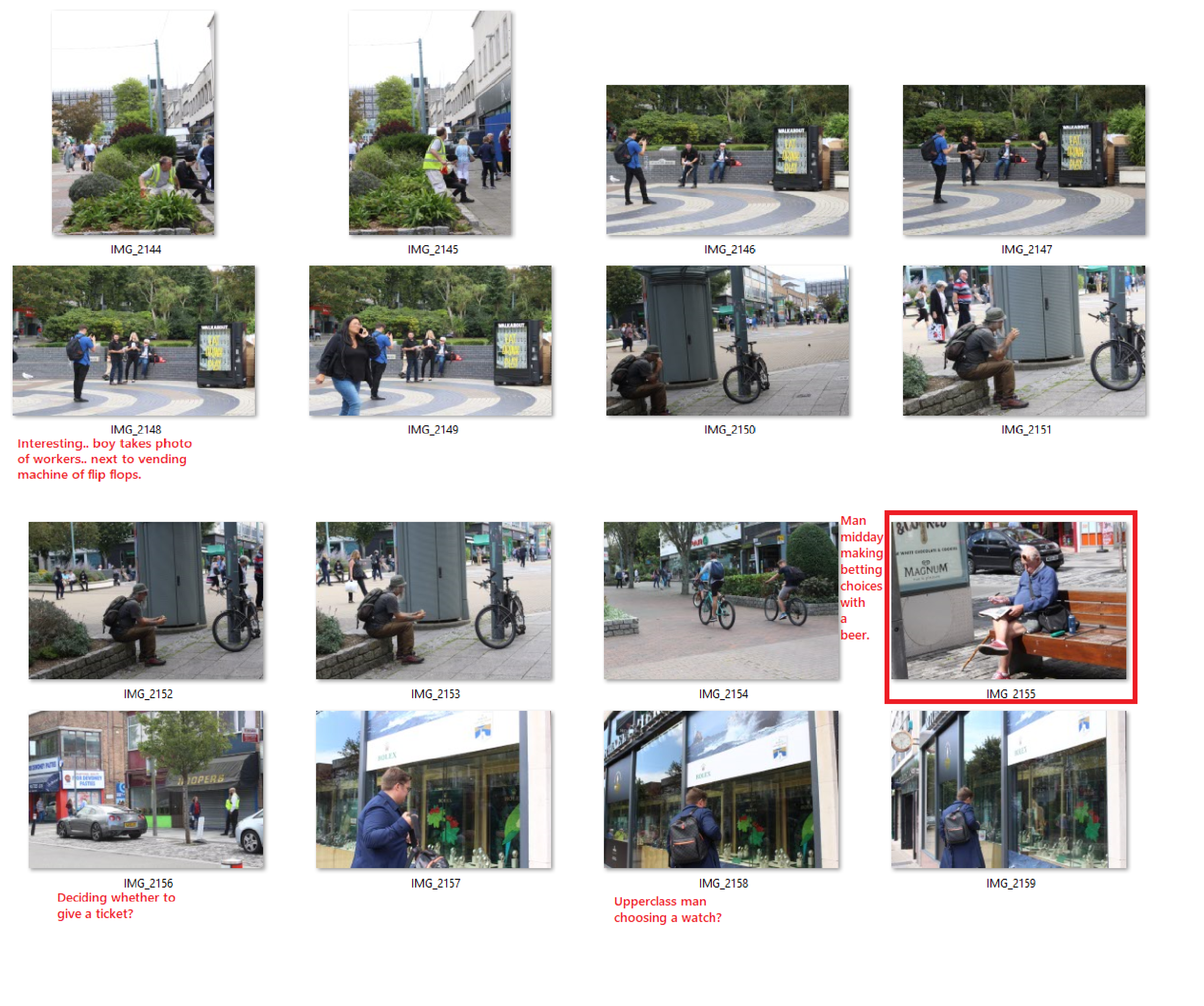
Checking my work against assessment criteria:
Demonstration of technical and visual skill:
I am happy with the technical and visual skills I demonstrated throughout this assignment. For a main city centre it was actually less busy than I visualised and therefore, my images weren’t as crowded with people as I though they would be. I didn’t really have a visual image of how they would come out but I am happy with some of the photos I have achieved.
Quality of outcome:
I am pleased with the overall outcome considering I caught the train there with no exact idea. I believe this portrayed my interpretation of the indecisive moment well.
Demonstration of creativity:
I tried to be as creative as I could, I tried to show differentiating aspects for example, the charity shop shoppers the high end shoppers.
Context:
On reflection I think I grasped the context of this assignment ok, it has definitely been a difficult one to get my head around as I find the Decisive moment is a minefield and it takes a lot of patience for that right moment to come along.
Strengths and Weaknesses:
I believe in reflection on my last assignment feedback that my research was a lot stronger this time. I put a lot more time into researching more in depth looking at youtube videos, reading articles and weblinks, in addition to this I have just got a pass for my local library so I can research into actual books so that not everything is online! So although, there is still room for improvement in this area I think oppose to last time it has been a lot stronger. I have also re-studied the Harvard referencing guide and ensured that all references are following relevant guidelines.
Reference:
Kim, E (NDG) Debunking the ‘Myth of the Decisive Moment’ https://erickimphotography.com/blog/2014/05/23/debunking-the-myth-of-the-decisive-moment/ (Date accessed: 24/08/2019).
O’Hagans, S (2014) Cartier – Bressons classic is back – but his Decisive moment has passedhttps://www.theguardian.com/artanddesign/2014/dec/23/henri-cartier-bresson-the-decisive-moment-reissued-photography (Date accessed: 24/08/2019).
O’Hagan, S (2014) Robert Frank at 90: the photographer who revealed America won’t look back.https://www.theguardian.com/artanddesign/2014/nov/07/robert-frank-americans-photography-influence-shadows (Date accessed: 24/08/2019).
Photopedagogy (NDG) The (in)decisive moment https://www.photopedagogy.com/the-indecisive-moment.html# (Date Accessed: 24/08/2019).
Sark, D (2018) The indecisive moment.https://www.davidsark.com/home/the-indecisive-moment (Date accessed: 24/08/2019).
Suler, J (NDG) The psychology of the Decisive Momenthttp://truecenterpublishing.com/photopsy/decisive_moment.htm (Date accessed: 24/08/2019).
Streaker, A (2010) In search of brilliant moments: street photography’s heightened existencehttps://www.lensculture.com/articles/matt-stuart-in-search-of-brilliant-moments-street-photography-s-heightened-existence (Date Accessed: 24/08/2019).
Stuart, M (NDG) About me http://www.mattstuart.com/about (Date accessed: 24/08/2019).
The Art Story (2017) Important art by Garry Winogrand https://www.theartstory.org/artist/winogrand-garry/ (Date accessed: 24/08/2019).
 Heather Wade OCA Blog